Qualification Process In Becoming A Firefighter

Becoming a firefighter is not at all easy. The risks and complexities of firefighters’ duties and responsibilities which have become more difficult and challenging because of the increasing complexities of modern living demand utmost knowledge, skills, steadfast personality traits, and other critical competencies on the part of the firefighters. This impacts on the qualification requirement and processes that aspirants have to go through and surpass.

Applicants for firefighting jobs have to possess the basic and academic requirement before they can go through a very rigid standard national selection process called National Firefighter Selection.

Applicants for firefighting jobs must be at least 18 years old and above. They must be in utmost health condition and must be physically fit. They must have formal academic qualification, at least Higher National Diploma and basic emergency medical technician certificate; training in emergency medical services may do if the state requirement allows. Related vocational degree courses may do for placement in fire engineering, fire safety and risk management or fire and explosion unit, depending on the state requirement.

Applicants for firefighting jobs have to pass the Personal Qualities and Attributes Exam and the series of qualifying interviews. They have to pass physical tests while wearing a full firefighter uniform. They have to pass a series of medical examinations including vision and hearing assessment, and drug and substance tests.

After passing the very rigid selection process, qualified applicants still have to undergo a series of firefighting training. Only those who surpass the training can become full-fledge firefighters.

Entrance firefighter exam study guide has been helping would-be firefighters qualify for the job since the 1950s through its custom-designed firefighter practice tests, promotional Assessment Center test preparation products, and entry-level seminars.

Entrance firefighter exam study guide includes 350 in-depth custom-designed practice examination questions on written comprehension, written expression, problem sensitivity, inductive reason, deductive reasoning, informative ordering, and visualization. It also contains over 175 practice examination questions on how to deal with situations and on the required personality traits and behaviors.

Every purchase of entrance firefighter exam study guide comes with the following: 1) encyclopedia of firefighter examinations containing over 500 questions divided into 16 of the most common testing subjects used on exams around the country; and 2) Don McNea Fire School’s Firefighter Hiring Guide Notebook containing firefighter examination preparation strategies and top-scoring test-taking and physical agility strategies.

What makes the entrance firefighter exam study guide unique is that each of its written practice tests is custom-designed to the test consultant who is giving the exam. These are not generic practice tests but specifically targeting the testing subjects for the test consultant, EB Jacobs, who conducts firefighting examinations.

Users of the entrance firefighter exam study guide gained competitive edge over other applicants and landed on the top percentile of the qualifying examination. The amount they paid for EB Jacobs test study guide has been proven a good investment because they were able to more than just recover it just within their first two hours as pledged firefighters.

Understanding Firefighters’ Job

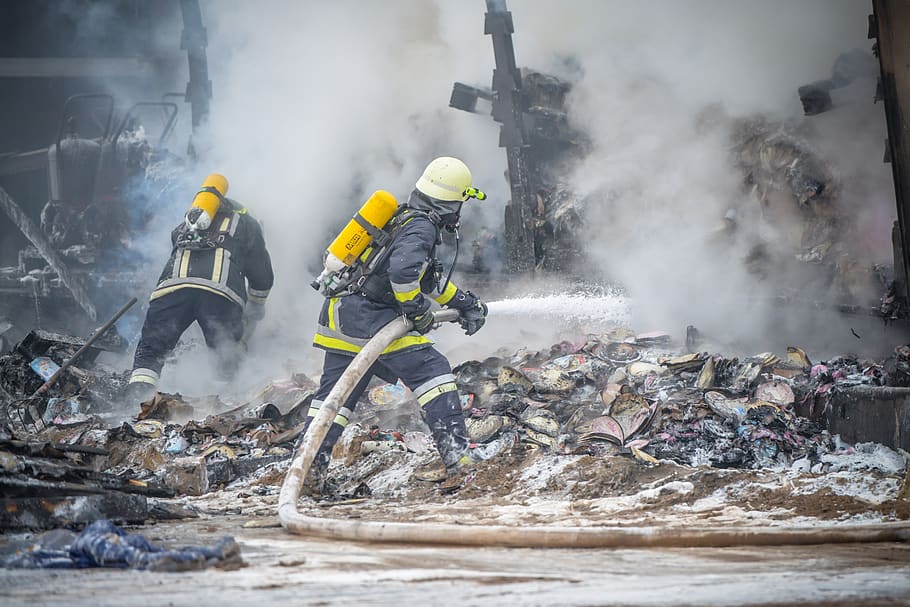
Firefighting jobs are certainly very risky yet extremely rewarding. A firefighter as defined is a rescuer extensively trained in firefighting. His primary role is to extinguish hazardous fires that threaten life, property, and the environment. His role extends to rescuing people and animals from dangerous situations not limited to fire. The job draws the best in every firefighter, hence, anyone aspiring to become one must be fully equipped and prepared.

Below is a long list of just some of the duties and responsibilities of a firefighter. Specifically, a firefighter must be able to-

•  conduct inspection of properties to ensure that they are in compliance with the existing applicable fire codes, ordinances, laws, regulations, and standards;

  • ensure that water hoses, fire extinguishers, and pumps are tested and functional;

•  prepare report and issue citations for fire code violations;

•  update the establishment of safety zones, hot zones, collapse zones, and other hazard areas found during the investigation;

•  conduct fire drills and training and make a report about it;

•  do maintenance duties such as ensuring that the firefighting equipment are clean and well-maintained;

  • be prepared at all times for any fire incident and be equipped for actual firefighting;
  • drive fire trucks and other emergency vehicles whenever assigned to;
  • assess traffic hazards in relation to apparatus placement;
  • execute the firefighting instructions of the incident commander during fire incident;
  • communicate with the incident commander for additional safety support
  • monitor conditions, operations, radio transmissions, and other activities;
  • provide a risk assessment of incident scene operation using the incident action plan;
  • prepare reports on emergency incidents, status of condition, hazards and risks to be submitted to the incident commander;
  • work closely with the law enforcement in investigating cases of arson.
  • ensure that the accountability system is being utilized;
  • testify in court against violations that occurred; and
  • attend in-service training classes to remain current in knowledge of codes, laws, ordinances, and regulations

Actual firefighters’ duties, however, goes beyond firefighting concerns. It includes emergency response and rescue mission even on incidents that are not fire related, specifically to- 

•  work closely with other emergency response agencies such as the police and emergency medical service in all emergency incidents that need rescue;

•  attend to injured people and ensure that possible rehab is not compromised; and

  • provide some degree of emergency medical service, in addition to working with full-time paramedics.

Firefighting skills and technology has become more difficult and complicated because of the increasing complexity of modern and industrialized living. This impacts the competencies required of firefighters. Those aspiring to become one have to pass rigid qualification processes.

cwh written exam has been helping would-be firefighters qualify for the job since the 1950s through its custom-designed firefighter practice tests, promotional Assessment Center test preparation products, and entry-level seminars.

cwh written exam has helped over 60,000 firefighter and promotional applicants attain that ultimate edge.

What makes the services of cwh written exam unique is that each of its products is custom-designed to the test consultant who is giving the exam. It specifically targets the testing subjects for that test consultant. No other company can match the detail it puts into its exam preparations.

The custom-designed examinations of cwh written exam are what make the difference in fire applicants continually scoring in the top percentile and getting that coveted fire department badge.

CPS Fire Test Questions

In every position, there is a qualification exam that each applicant will undergo. For the aspiring firefighter, the Cooperative Personnel Service test is the assessment that they have to take in order to know if they are qualified for the firefighting job. The applicant needs to make a thorough study, practice, and exercises as preparation for the CPS test. Mostly, practicing of answering the CPS fire test questions available on the internet or from purchased books as for mock test, it will give the applicant a preparation and strong foundation for the training and tools that they needed on passing the actual CPS. It is important for the test takes to know what the types of test questions are does this CPS examination composed of. Further practice on the questions that nearly provided questions from the actual test as practice will give them assurance and confidence to be one of the high scorers.

Before taking a firefighter CPS examination, examiners have to know that this exam is composed of multiple-choices questions type exam and needed to be done in just two hours. So before, taking the test, practicing answering the questions for a quick and accurate way is a must. The examination is composed of questions from the reading comprehension skills. It is the reading and understanding of written information or instruction. Every aspiring firefighter applicant must be able to read and understand written materials, even symbols and signage familiarization from the public, and any incidents are included. There are also some instructions and warning that each firefighter has to familiarize from the tools and equipment being used in every response act of the team. The understanding of oral information and directions is also part of the exam to be measured. It has to test if the applicant can follow the captain’s commands in times of an emergency. It will conclude if an applicant can listen and properly follow spoken information. In this test, listening to the recorded passage will be conducted and they will answer the question based on what they heard from the recorded passage, the applicant with the good recall accuracy will get above from the others.

In a CPS fire test questions, some questions could measure the numerical skills. This is where the questions are pertaining to the mathematical ability of the applicant. The basic operation such as addition, subtraction, multiplication, and division, together with this is the fraction and percentages. As part of measuring good analytical skills, interpreting the maps, charts, and diagrams is part of the test questions. It is also a must to know the mechanical skills and knowledge of the applicant, so a mechanical test is included.  The questions in this section test the applicant’s understanding and knowledge of certain equipment and tools such as pumps, pulleys, and levers.  And other skills to measure of the cps fire test questions is the teamwork, public, and community relations. It is the same as the personality test where it judges the applicant if they are fit for the firefighting job and culture. A firefighter used to work with a team, and it is very important to build good interpersonal skills as an act of professionalism. Good relations to the public and community while they serve the public as firefighter personnel.

Fire Fighter Psychological Examination

In every hiring process, Psychological Examination is a very important criterion. It is where behavior, personality, and capabilities are being tested with the use of a combination of techniques to help arrive at some point of hypotheses or individual psychological assessment results. Hiring new employees is a critical part of any organization. Many organizations have begun to incorporate psychological testing into the hiring process to decrease the risk of making a hiring mistake. But what are the roles should these tests play when selecting a firefighter? It is known as psychological testing or assessment. Becoming a firefighter is a kind of heavy occupation but so rewarding for an individual who made the job well done. Firefighters are put through Psychological Examination because they are put in some serious and psychologically distressing events. The department needs to know if an individual can deal with these certain situations and can manage his emotion and thoughts. This test is implemented to identify candidates with the suitable mental ability to pass the training, and emotional stability to face the stress associated with being a firefighter.

This firefighter psychological exam includes the ability of an individual to work with the team or group since they are always run to risk their lives with the team helping one another to save lives and property from any incidents, especially fire. It also encompasses how they do make their work habit. There is also knowing one’s attitude, behavior, judgment, reasoning, emotional adjustment, compassion, honesty, malleability, initiative, etc. There are lots of things to consider when it comes to assessing one’s psychological capacity. Another great factor with this test is how to handle the situation or the given problem, the decision making makes a remarkable part of it because being a firefighter is a matter of life and death. Loyalty to the service is also a part, the leadership and ethical aspects are both important for choosing the best suit individual for the job.

Firefighters are literally strong and have to be tough at all times of incidents. The gender, male or female, is not a hindrance to making a heroic act for the countrymen. However, not all men are qualified to do the job, each individual has its strength and weaknesses, nobody is perfect as the old saying says. Most firefighter psychological exam incorporate different types of personality inventories designed for public safety employment screening, a stress inventory, a comprehensive personal history review, and a clinical interview with the psychologist.

A firefighter psychological exam is one of the medical examinations that have to pass by the aspiring applicant for a firefighter position. The commitment that firefighters perform is physically and mentally stressful. They are serving at accident scenes and fires that cause damage to property, injuries, and sometimes, fatalities. Anyone striving in this type of environment must be psychologically stable. Firefighters act as a team, and all members of that team must be capable to work synchronically so that they do not endanger themselves, coworkers, other emergency personnel, or the public. The first part of the psychological test is a pen and paper exam where the applicant answers a series of questions. Rather than try to figure out what data does the tester is looking for and leaning your answers in that direction, a better policy is to answer each question honestly and uprightly. Once you have completed the written portion of the test, you will be questioned by a psychologist, he or she will ask you questions based on your answers. Following the process is complete, a Pass or Fail grade will be given.

Differences in Test Questions

Becoming a firefighter is a lengthy process and varies from department to department. Many fire departments require some written tests in addition to the physical tests when they hire new firefighters.

However, there is still no standardized test among states, which makes getting information regarding the process difficult. There are some similarities, though, between the tests in terms of when candidates take the tests and some of the test contents.

There are some differences though in what departments are looking for. These actually separate them from state to state with regards to firefighter exam.

Taking the test

These tests are usually administered as an after step in the application process. Usually, there are postings on applications and resumes to be submitted. Afterwards, there will be application reviews going into the tests.

Some departments or fire department systems use the submission of test result with an application. (In California, firefighter exam for open positions are available for registration right after a candidate submits an application.)

Different tests

Departments have their own goals and content for the firefighter exam itself. Some department systems may collaborate and create one standardized test for an area. Other smaller departments write their own individual test based as important for their firefighter.

Fire departments in Northern California are more concerned with wildfire threats in contrast to those in urban areas who are more concerned with building fires or public safety threats.

Contents

The tests are not really very job-specific. There are some general education type of questions and some basic education ones.

In paramedics, the questions are usually to determine the qualifications of the candidates. However, those questions are now included in behavioral questions.

Department-specific

Some departments have their current members take a test in order to create a baseline for what they want in the future candidates. This is also to determine what traits are desirable for a certain department.

Other departments tests only for general education. However, they follow this with an oral board review or panel. All of these are still determined by what a department has decided what is necessary for their specific stations.

Formats

The testing formats usually are in multiple choice types. Some may include free-form response questions.

These days, the tests have started to be leaning towards questions regarding the psychological nature of a person’s behavioral type.  The aim is to find candidates who are introverted or extroverted.

They also would want to find out how well the candidate work with groups, how well they work on their own or how they handle situations when faced with a difficult situation.

Preparing for the tests

It is always helpful when preparing for the general education aspects of the firefighter exams. Brushing on education topics can improve scores. This is especially true for individuals who have not been recently in school and rusty in academic subjects.

Some agencies have sample test questions and give candidates a small listing of sample questions from that department. These are test prep materials based on general testing format on the firefighting exam.

Many times, candidates may be thrown off by behavioral questions in the exams. There is just no way to know what a department may seek from the candidates.

The Skills that should have as Firefighter

Firefighters are the trained professionals you call at the scene of a fire or emergency. For this reason, they rely on advanced tools and equipment to handle the situation. A firefighter is a trained emergency response specialist who serves to protect public life as well as property. Just like law enforcement officers, becoming firefighter work first and foremost to protect lives, and then they turn their attention to protecting property; but, not against crime but fire and emergencies. At the scene of a fire, firefighters have many duties. So, they use their equipment to ensure that water goes where it is needed. Also, firefighters rescue victims trapped in buildings or other structures and administer emergency medical treatment when needed. They attempt to salvage the consuming structure and any of its substances. When not responding to a fire or emergency call, firefighters clean and maintain equipment, perform fire drills, as well as complete paperwork relevant to emergency incidents. Although fighting fires might be their main job description, becoming a firefighter often engage in different activities like educating the public on how to handling medical emergencies with rescuing and treating the injured.

Prepare written reports on emergency incidents like tests and recommend new equipment. So, the overall duty of becoming a firefighter includes attending the scene of fires and other emergencies including motor, industrial and marine accidents. Rescuing and evacuating people in life-threatening situations. Operating siphons, spraying water, foam, and chemicals from hoses, portable quenchers, and different appliances to douse fires and to scatter or neutralize dangerous substances; cutting openings in buildings and crashed vehicles to free occupants. Becoming a firefighter has to administer first aid, attending and participating in training activities, rescue classes, drills, demonstrations and courses in emergency and fire-fighting techniques. Guaranteeing all devices and gear is in the acceptable working request through regular maintenance. Participating in search and protect and high angle salvage operations and assisting different agencies in crises. Becoming a firefighter, you can work across various emergency response departments across the federal and state levels. You can also work in rural areas or smaller towns. Becoming a firefighter also share the same duties as paid firefighters and can work in various areas too.

So, generally, becoming a firefighter work in the following areas like local government, including education and hospitals, administrative and support services. When reacting to a crisis, these laborers frequently wear defensive gear, which can be exceptionally heavy and hot. When not in the field, firefighters work at fire stations, where they sleep, eat, work on equipment, and remain on call. Whenever an alarm sounds, firefighters react, regardless of the weather or time of day. There are varying requirements by becoming a firefighter for different jurisdictions, but generally, the basic requirement to become a firefighter. While education and training vary across different jurisdictions, it is important to get a fire science degree to create more career opportunities for you. Fire Science majors at the bachelor’s level may also join classroom study with field training and/or an entry-level position. They also study many aspects of the fire service profession, such as fire behavior, fire extinguishment, rescue procedures, and environmental policy.

Becoming a Paramedic

Licensed EMT-P (emergency medical technicians – paramedic) are basically the professionals who provide advanced emergency treatment to patients in a pre-hospital setting. Paramedics can reduce the hospital stay of patients by preventing more serious injuries happening when incorrect treatments are administered before hospitalization.

Saving lives is considered the most rewarding aspect of a paramedic’s career. Worldwide, there is a high demand in both private and fire department settings.

Preparations

Aspiring to be an EMT or paramedic can take anywhere from one to three years, depending on the applicant’s choice of career and education path. EMT training focuses on life support techniques in first response situations, including CPR, tourniquet application, and treatment of wounds.

Paramedics deliver more advance procedures and must require more extensive education and training. The basics focuses on the educational steps needed to enter the field.

First responders begin their careers as EMTs to gain experience before pursuing additional training to become paramedics. In addition to performing all of the same treatments and procedures as EMTs, paramedics are also trained in advanced skills as administering IVs and providing respiratory procedures.

Many first responders begin their careers as EMTs to gain experience before pursuing additional training to become a paramedic. In addition to performing all of the same treatments and procedures as EMTs, paramedics are also trained in advanced skills such as administering IVs and providing respiratory procedures.

Education

Learning how to become a paramedic starts from the Paramedic school.  The first requirement would be that the applicants must be a high school graduate or have its equivalent.

Applicants must also have a current EMT-basic certification and must have worked in the field (on pre-hospital experience) with at least 2000 hours of paid work experience.

Added to that will be that applicants much must have completed a college level anatomy and Physiology Bio 1435 and the paramedic prep classes.  

Requirements

Acceptance into the paramedic school program is by application and the applicant needs to undergo testing and interview process.

The paramedic school academy is by two semesters. The first semester is the lecture portion and the program and the second semester consists of four weeks of work in the hospital clinical setting performing direct patient care.

Internship

After which, there is a field internship for the rest of the period which is approximately two-and-a-half to three months.

The internship gives the applicant hands-on field training working alongside trained paramedics in area fire departments or private ambulance services. This will prepare him to take the National Registry EMT-P exam for licensure.

Notes

To join in the hours required for the clinical internship, applicants are required to have a flu shot and/or H1N1 vaccine. (Applications are cancelled if the applicant does not undergo such procedures.)

All paramedic students, once accepted into the paramedic program must also submit a copy of current TB (tuberculosis) test results that are less than one year old. The TB test should be current during the duration of the entire course. Should it expire, the applicant needs to have it renewed.

There is also a background investigation that must be completed first before acceptance into the paramedic program.

Design a site like this with WordPress.com
Get started